Find a Grave

Search for cemetery records in Saint Clair Cemetery, PA at by entering a surname and clicking search:

Restrict search to

Surname
Showing posts with label civil war. Show all posts

Wednesday, January 25, 2017

Wordless Wednesday: Frank's Civil War Diary

I've been writing off and on about cousin Frank C DORRINGTON from Allegheny Co, PA.  His picture taken in Washington, DC, just before his regiment moved out after protecting our Nation's Capital during a time of great strife, inspired a mini-series of blogs.  Check out the You, 149th PA Bucktail You tidbits posted previously on Frank and his messmates.  They eventually made their way as they served the Union to a small town in PA called Gettysburg.

Today, I was looking around and found mention of his Civil War Diary.  His diary!  Now comes the hard part.

It was donated to Penn State in 1968 by an Ernest FREY of Pittsburgh.  Hmmm, who is he and why did he have the diary?

As far as I know, old Frank had only the three daughters born after the Civil War and all who died before 1907.  I have also found grandchildren.  But so far, no connection to FREY.  The Ernest FREY I have located did reside close by, but I see no connection yet.  Hmmm, what is that connection?

FREY was an attorney.  Hmmm, what is that connection to the diary?  Looking at his immediate family offers no clues.

I contacted the Penn State Library to see if I could access the diary from far away.  Suffice it to say, no.

I won't give up.  I will find a way to access that diary.  Who knows what tidbits of information I can glean from it?

Ahh, genealogy.  With a rebel yell, I cry more, more, more.  Even if I am wordless on this diary.  It's calling to me and I must answer.

Read more of cousin Frank and his friends:

Part 1 of the series:  Frank?  Is That You?  You 149th Bucktail You
Part 2 of the series:  Ustick?  Is That You?  You, PA 149th You
Part 3 of the series:  Dave? Is That You? You, PA 149th You
Part 4 of the series:   Boy? Is That You? You, 149th PA Bucktail You

Sources:
https://journals.psu.edu/wph/article/viewFile/2979/2810


©2017 ASEldredge

Tuesday, August 9, 2016

Tombstone Tuesday: Boy? Is That You? You, 149th PA Bucktail You

Part 4 in the series You, 149th PA Bucktail You

Boy MAY?  Was there a translation error of old?  Or was Robert John MAY called "Boy" by his comrades in arms in Company D of the PA 149th Bucktails?

Robert John MAY was also part of the frenzy that joined the Civil War when James GLENN gave recruitment speeches in August, 1862, in Allegheny Co.  I guess cousin James was a pretty good speaker, along with the others who spoke, as many boys made the transition to fighting men shortly thereafter.

MAY was born in 1830.  To date, finding his parents' names has not been successful in my limited search for them.  Nesbit's history of the unit provides a great sketch of his life.  With his sketch, I was able to flush out some more details.


From Nesbit's History of the PA Bucktails, Co. D

Wife:  Sara HUDDLESTON, b. 1830-1835 in St Louis, Missouri.  Suspect they were married there as well.

Children:
Ida or Ada-  found in 1860 census in St Louis with her parents.  Dies before 1870.  Buried Uniondale Cemetery.
Edgar- b. Feb 28, 1861 d. April 28, 1913.  Unmarried.  Buried at Uniondale Cemetery.
Arthur- b. July 4, 1866 d. June 8, 1943  Buried at Versailles, McKeesport, Allegheny, PA.
Mary- b. May 28, 1870 d. June 7, 1958 wife of Frank BEAM, Buried at Versailles, McKeesport, Allegheny, PA.


Why am I looking at Robert John MAY?  The 1863 letter of cousin Frank DORRINGTON states he had a picture made with him and four others.  Frank's words:  "No 1 Ustic ROTHROCK, our bugler, No 2 Dave PHILLIPS, No 3 Boy MAY, 4 I B MOMYER, 5 Sam PHILLIPS, No 6 your humble servant."


Is this the picture?  Look at the man in the middle sitting.  I imagine he felt somewhat relaxed and cocky that day.  Look at the eyes and compare them to the older picture of MAY.  Yeah, I think that's him.

I tried to find his tombstone and his obit with no success.

Ahh, genealogy.  Sometimes, we just need a stone.  Rest peacefully Boy MAY.


Part 1 of the series:  Frank?  Is That You?  You 149th Bucktail You
Part 2 of the series:  Ustick?  Is That You?  You, PA 149th You
Part 3 of the series:  Dave?  Is That You?  You, PA 149th You


Sources:
http://whispersofgenealogypast.blogspot.com
Year: 1880; Census Place: Mckeesport, Allegheny, Pennsylvania; Roll: 1088; Family History Film: 1255088; Page: 372D; Enumeration District: 041; Image: 0749
Ancestry.com. Pennsylvania, Death Certificates, 1906-1963 [database on-line]. Provo, UT, USA: Ancestry.com Operations, Inc., 2014.                     
http://digital.library.pitt.edu/cgi-bin/t/text/pageviewer-idx?c=pitttext;cc=pitttext;idno=00hc08553m;q1=philips;frm=frameset;view=image;seq=138;page=root;size=s
Nesbit, John W.  General History of Company D, 149th Pennsylvania Volunteers: and Personal Sketches of the Members
http://civilwartalk.com

©2016 ASEldredge

Monday, August 8, 2016

Military Monday: Dave? Is That You? You, PA 149th You

Part 3 in the series You, PA 149th You

Can you imagine the scene after a soldier is left for dead on the battlefield during the Civil War?  It couldn't have been a pleasant experience for either side.  In this case, the soldier was found alive later and sent to the hospital.

David PHILIPS, born May 6, 1835, in Scott Twp, Allegheny, PA, was the son of Henry Hultz PHILIPS and Adeline LONG.  In the Federal Census for 1860, he is living next to Henry and Adeline, and next to Thomas PHILIPS.  The census tells us his wife is Elizabeth and they were married in 1860.

David enlists during the frenzy of local boys joining Captain James GLENN on August 22, 1862.  These boys become the men of Co. D, PA 149th who walked to hell and back during the course of their three year enlistment.  David received a gunshot wound to the head at Laurel Hill, VA.  Left for dead!  For three days!

He did recover and returned to fight with his unit.

From Nesbit's book on the History of the Regiment
After the war, he returned to Allegheny Co, PA, and settled in Wilkinsburg as a machinist.  His wife passed.  Around 1892, he married Anna. He lived his life and passed away Feb. 9, 1913, and was buried at Southside Cemetery.

Why am I looking at him?  The 1863 letter of cousin Frank states he had a picture made with him and four others. Frank's words:     " No 1 Ustic ROTHROCK, our bugler, No 2 Dave PHILLIPS, No 3 Boy MAY, 4 I.B. MOMYER, 5 Sam PHILLIPS, No 6 your humble servant."

Is this the picture?  Look at the man standing behind who I have identified as Ustick ROTHROCK in the first bugle position.  Dave?  I think so.


I located his obit in the Pittsburgh Press dated February 10, 1913.  I thought his survival and success after the war needs a shout out.

Pittsburgh Press February 10, 1913


 Ahh, genealogy.  How many men have survived? How many men have we lost?  Take a moment and remember them all.   Thank you for your service American veterans.

Part 1 of the series:  Frank?  Is That You? You 149th Bucktail You
Part 2 of the series:  Ustick?  Is That You?  You, PA 149th You


Sources:
http://genitalesga.blogspot.com/2011/04/1863-civil-war-letter-from-member-of-pa.html
http://www.pa-roots.com/pacw/infantry/149th/149thcod.html
http://civilwartalk.com/threads/149th-pa-at-gettysburg.90596/
http://digital.library.pitt.edu/cgi-bin/t/text/pageviewer-idx?type=simple;c=pitttext;cc=pitttext;idno=00hc08553m;q1=philips;submit=Go;didno=00hc08553m;rgn=full%20text;view=image;seq=0165
http://interactive.ancestry.com/5164/41381_620305176_0822-02254/356353?backurl=http://person.ancestry.com/tree/6687227/person/6980841523/facts/citation/107690121404/edit/record
Historical Data Systems, comp.. American Civil War Soldiers [database on-line]. Provo, UT, USA: Ancestry.com Operations Inc, 1999.     
1860 Federal Census, Chartier, Allegheny, PA   

©2016 ASEldredge     

Friday, August 5, 2016

Friend of Friends Friday: Old Edisto

Edisto Island is a delight to visit in the Low Country of South Carolina.  Drive down most any dirt road and be surrounded instantly by beautiful old oak trees covered in spanish moss.  For me, leaving the hustle and bustle behind for this relatively quiet island is just what is needed to fully relax.  Of course, walking even a couple of feet in to the dense undergrowth just off the road has never been on the menu for me.  I wonder what it was like for the British and later, the Union, to navigate the dense undergrowth with its accompanying wildlife.

Relaxing on the island wasn't always possible for the locals in the past.  The island was populated by Edistow Indians in the 1500s.  Through time and wars, the island survived, although the populations changed.  In 1860, there were over 5000 slaves reported on the major plantations owned by the planters.  Many of these names can be found due to the gracious translation of others.

With its remote and limited access, General LEE decided not to defend the island, but rather, asked the planters to evacuate.  The slaves were left behind.  The Union forces did overtake the island and sent many slaves to St Helena Island.

After the war ended, the free slaves returned expecting to receive land as had been promised by President LINCOLN.  History tells us this did not happen.  Instead, the titled owners returned and now had paid employees.

It wasn't until decades later that bridges and roads were improved so the getting to and getting off the island became easy.

Several years ago, I was given a book on Edisto by a beloved family member who knew of my affection for the island.  This book was written in 1955 by Nell S GRAYDON with photography by Carl JULIEN.  What makes this book so special? It is signed by both of them.  In addition, the chain of ownership is documented in the book with the last owner being dear friends of the family.

Within this book are stories of the plantations and of the Negroes in the area.  While there are no stories about slavery per say, there are a couple of stories about those who were alive as children when the war ended.  In it are fascinating reads of Maum Rachel, who delivered children of the island.  This story takes place right after the end of the war, when she and the new doctor learned they could work together in a difficult birth.  Another story is that of Josephine WRIGHT,  who remembered the "last big gun shoot."

Of interest is also knowing that a slave cabin from the old Point of Pines Plantation now resides in Washington at the Smithsonian.  I wonder who would be more surprised--  the plantation owner or the slaves who lived in it?

Ahh genealogy.  Going back in time on Edisto through a book takes me to a place where time seems to almost stand still. Almost.


Sources:
http://edistoscenicbyway.org/history.cfm
https://www.fold3.com/page/111581445_slaves_in_the_estate_of_william_seabrook_edisto_island_sc_1860#description
http://www.nytimes.com/2013/05/19/us/slave-cabin-to-get-museum-home-in-washington.html?_r=0

Wednesday, August 3, 2016

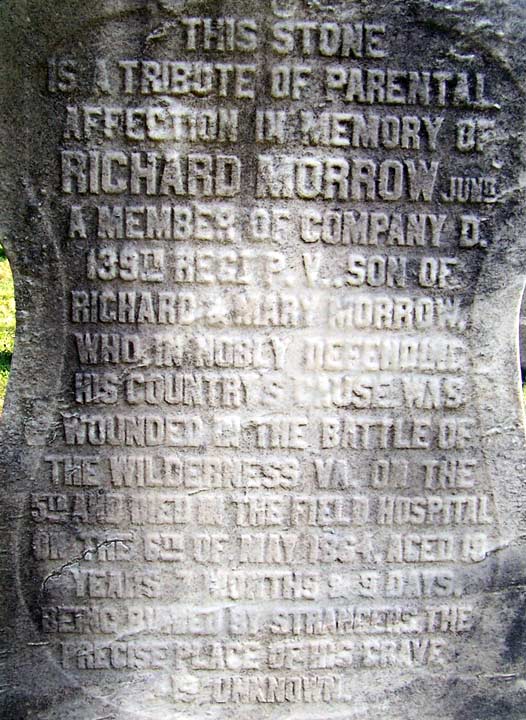
Wordless Wednesday: Death at the 1864 Wilderness Battle


Richard MORROW, Jr
PA 139th Co. D
Wounded May 5, 1864 Battle of the Wilderness
Died May 6, 1864  Field Hospital
Beloved son of Richard MORROW and Mary MILLER
Age at death 19 years, 7 months, 9 days
Date of Muster September 1, 1862
Monument at Pine Creek Cemetery, Allegheny Co, PA


The 139th was positioned at the Brock Road and Plank Road area.  Which field hospital was closest? There was a field hospital on the nearby Carpenter Farm with 4 grave areas. Could his remains have been buried there?  

Ahh, genealogy. What a beautiful monument for the youngest son.  Gone way too young, but remembered so many years later. Rest in peace, young Richard.


Sources:
http://www.findagrave.com/cgi-bin/fg.cgi?page=gr&GRid=116337324
http://www.usgwarchives.net/pa/allegheny/tsphotos/pinecreek-hampton/morrow-richard6.jpg
http://www.pa-roots.com/pacw/infantry/139th/139thcod.html
http://www.hamptonmagazine.org/dec-jan-issue-2014-15/cover-story/
http://spotsylvaniacw.blogspot.com/2012/02/hospital-burial-site-on-carpenter-farm.html

©2016 ASEldredge

Tuesday, August 2, 2016

Tombstone Tuesday: Ustick? Is That You? You, PA 149th You

Part 2 in the series You, PA 149th You


Ustick ROTHROCK, Lewistown, Mifflin, PA

Ustick ROTHROCK.  Now, that's a name not to forget.  Ustick caught my attention when it was first seen in the February 1863 letter written by Frank C DORRINGTON of Co. D of the PA 149th.  In the letter, cousin Frank encloses a picture taken with some buds in Washington, DC, as the regiment was on duty in defense of Washington, DC.

ROTHROCK b. 1836 was son of Joseph and Mary ROTHROCK.  His father, Joseph, was a stage driver and is found in the 1850 in Lewistown, Mifflin, PA.  Life carried on and then war broke out in America.  Ustick, a blacksmith at the time of his enlistment in August 1862, according to his wife's pension application in his name, volunteered.

ROTHROCK was the bugler for Co. D of the PA 149th Bucktails.  In addition, he was a sharpshooter who performed his duty well.  In the history of the regiment by John Nesbit, ROTHROCK escaped the war without wounds or sickness.

From Nesbit's book on the History of the Regiment


After he mustered out with the regiment in 1865, he settle into normal life.  He married Margaret SMITH and had three children; Cora b. 1875, Florence b. 1879 and Grace b. 1884.

Somehow, I am convinced the injuries he suffered were unseen by the general public.  As we of today know, the atrocities of war can lead to lasting issues such as depression, nightmares and end in suicide.  ROTHROCK was at Gettyburg for that fateful battle as well as all the other battles the regiment saw action.  He witnessed many of his friends fall and perish on the battlefield.  Some estimates say up to around 75% of the regiment fell in battle.  Did he have survivor's guilt?  Could he just not shake the images of the past when Americans fought and killed Americans?  He had a good job.  He had a home.  He had his demons of the past.

Did his demons lead to the label of lunatic for the last 26 years of his life?  After a two month complaint of acting insane, he was declared insane and confined to the Hospital for the Insane at his inquisition.  Even in the inquisition papers, it refers to ROTHROCK as "the lunatic."  It saddens me that we won't know the truth, although I suspect he had PTSD.

Corporal Ustick ROTHROCK passed away November 29, 1916.  While he appears to have had a sudden stroke, he also had the official diagnosis of manic depressive psychosis.

Why am I looking at him?  The 1863 letter of cousin Frank states he had a picture made with him and four others.  Looking at the picture, I see the bugle in the hands of PA 149th soldier number one.  It corresponds with Frank's words  " No 1 Ustic ROTHROCK, our bugler, No 2 Dave PHILLIPS, No 3 Boy MAY, 4 I.B. MOMYER, 5 Sam PHILLIPS, No 6 your humble servant."

Is this the picture of these men?  Look at the features of man number one and the later picture of Ustick.  The eyebrows, cheeks and nose are similar.  Could it be?

Ahh, genealogy.  The sands of time pass after war, but the memories are forever.  Would he have been able to live with his demons if he had stayed in Pittsburgh after the war and been able to talk with his comrades?  Rest in peace, Ustick.
And thanks to all veterans of America.


Part 1 of the series:  Military Monday: Frank?  Is That You? You 149th Bucktail You 

 Sources:
http://genitalesga.blogspot.com/search/label/dorrington
http://civilwartalk.com/threads/149th-pa-at-gettysburg.90596/
Ancestry.com. 1850 United States Federal Census [database on-line]. Provo, UT, USA: Ancestry.com Operations, Inc., 2009. Images reproduced by FamilySearch.
Original data: Seventh Census of the United States, 1850; (National Archives Microfilm Publication M432, 1009 rolls); Records of the Bureau of the Census, Record Group 29; National Archives, Washington, D.C.
http://mv.ancestry.com/viewer/e834e51f-974c-4d4f-87a1-1435be2fadf4/28945733/12351776261
Nesbit, John W. General history of Company D, 149th Pennsylvania volunteers: and personal sketches of the members University of Pittsburgh, University Library System., Digital Research Library.
http://digital.library.pitt.edu/cgi-bin/t/text/pageviewer-idx?type=simple;c=pitttext;cc=pitttext;idno=00hc08553m;q1=rothrock;submit=Go;didno=00hc08553m;rgn=full%20text;view=image;seq=0001;node=00hc08553m%3A1
http://www.findagrave.com/cgi-bin/fg.cgi?page=gr&GSln=rothrock&GSfn=ustick&GSby=1836&GSbyrel=in&GSdy=1916&GSdyrel=in&GSst=40&GScnty=2284&GScntry=4&GSob=n&GRid=52104503&df=all&

©2016 ASEldredge

Thursday, July 14, 2016

Those Places Thursday: Cremo College, Site of Reconstruction and Freedom in Charleston

Riding around Charleston was always in the plan as we visited family when I was a child.  Walking around the old streets so chock full of history takes me back in time, especially when my mom used to tell me stories of old houses and buildings.  What she didn't tell me was the history of Cremo College, aka The Cigar Factory.


The Cigar Factory first started its life around 1882 as a cotton mill after the Civil War.  The South was in ruins and this five story building had a major impact on the helping the economy during the Reconstruction time after the ravages of war.

Fast forward to the beginning of the 20th century.  In 1903, the American Cigar Company leased the property as the company started production in five locations in the South.  Women, both black and white, were the mainstay of the employees who prepared the tobacco leaves, made the cigars and packed the cigars.  They were unskilled labor, yet this employer was the major private employer in Charleston for a number of years.  Generally, the higher paid positions went to the caucasian males.


The Cigar Factory produced two cigars, the Certified Cremo and Roi-Tan.  According to what is written, the combination of young employees and the large production numbers of the Cremo Cigar gave rise to the nickname "Cremo College."

The Cigar Factory also has another prominent spot in history as it is believed the song "We Shall Overcome" was first sung during a six month strike in 1945 led mostly by the black employees, who were the majority of the employees.

When I was told some ten years ago, that my great grandmother had worked at the cigar factory, I was surprised. When and why?  She was born just before the Civil War and lost her father during the war.  Both sides of her family lost everything, men and farms, in the war.  She married in 1883 and spent the next years raising a family.  I suspect she started work there after the death of her husband in 1922.  I had visions of her being a secretary.  Why did I think that?  Most likely, she was one of the poor working white women who either stripped the leaves, or rolled the cigars or packed them.

The 1920 census tells me she has no job other than being a wife.  The 1930 census tells me she had moved to Grant Homes on Meeting Street where she is still listed as no job.  She was around the age of 70 at that time.  Would she still have had to work?

While I don't know exactly what she did or when, the information I can find on the Cigar Factory tells me she worked long hours for that small paycheck.  I have yet to find any employment records of the Cigar Factory.

Now, when I ride past the newly refurbished Cigar Factory, I picture her with her beloved snuff and her petticoats.  And I wonder.

Ahh, genealogy.  Guess we finally overcame the Cremo College, once and for all.  Now I just want to read the new novel about the factory.


Sources:
http://cigarfactorycharleston.com/about/
http://ldhi.library.cofc.edu/exhibits/show/cigar_factory/historic_background_cigar_fact
http://www.postandcourier.com/article/20121027/PC1002/121029351/
http://www.sciway.net/sc-photos/greenville-county/american-cigar-factory.html
https://www.sc.edu/uscpress/books/2016/7590.html

Friday, June 24, 2016

Friday Faces of the Past: Whisper Those Pee Dee River Names in the 1844 SC Militia

Cruising along the waters of the Great Pee Dee River in South Carolina has been a journey.  Gone are the plantations of old.  Gone are many memories.

Found today, however, is the 32nd South Carolina Regiment of 1844. Wait... 1844?  That seems a little early to be getting ready for the Civil War, or the War of Northern Aggression.  Or is it?  This 1844 petition signed by the Marion area men is a new find for me.  The petition signers ask for a dedicated muster ground for their battalion rendezvous so they can minimize crossing the Pee Dee River.  The location suggested is on the southwest side of the river.  What was cool was seeing the almost four pages of names that started jumping off the page, kind of like fish jumping just waiting to be caught.  Grandpas, uncles, cousins--  they are all there with their neighbors.


Why was there such a big militia at the ready in 1844?  Back up a few years in our nation's history and think of John C CALHOUN and his opposition to the Federal Government and its 1832 Tariff Act. South Carolina threatened to secede if the Federal Government enforced the tariff as the state saw it as a way to bring the south to obedience. Hmmmm... sounds familiar.

In 1832, South Carolina adopted the Ordinance of Nullification, as a formal protest, and to see if the Federal Government would honor the principle of states' rights. The next month the Federal Government issued a warning to South Carolina and passed the Force Bill which authorized use of force to collect those nasty tariffs.

At the same time period in 1832-33, South Carolina revamped its militia. Thus the birth of the 32nd Regiment South Carolina Militia which was mostly made of Marion men.  The men met every two months for drills.  There was no pay for service.  This practice continued up to the time that South Carolina actually did secede from the Union, some thirty years later.

Interesting tidbits emerge and help me to understand more of my country's past.  Reading the history means just so much now then when it did in school.

Ahh, genealogy, let me count those names on the 1844 petition.  And let me see how many I share blood with--- POSTON, GIBBBS, COX, FINKLEA, SINGLETARY.  Time to hit those genealogy files to confirm more names!

Sources:
Rice, William. A Digested Index of the Statute Law of South Carolina, from the earliest period to the year 1836, inclusive. https://books.google.com/books?id=16JXAAAAcAAJ&pg=PA209&lpg=PA209&dq=1832+south+carolina+militia+laws&source=bl&ots=PDq4lIAtyp&sig=VxqGVPTe2INwpr2d2fXyfe5TtOM&hl=en&sa=X&ved=0ahUKEwj9rrPYxL7NAhWGVyYKHTSsCHQQ6AEIKTAC#v=onepage&q=1832%20south%20carolina%20militia%20laws&f=false
Sellers, W W. History of Marion County. South Carolina, from its earliest times to the present, 1901.
SC Department of Archives and History, Petitions to the General Assembly S165015 http://www.archivesindex.sc.gov/onlinearchives/Thumbnails.aspx?recordId=257881
http://www.britannica.com/topic/nullification-crisis
http://www.u-s-history.com/pages/h333.html

©2016 ASEldredge

Thursday, March 26, 2015

Those Places Thursday: Hell Hole Swamp, Seriously?

Imagine spending a delightful afternoon talking with a quiet, gentile lady of the old South and, then, trying to keep the emotions on your face under control when she spits out something that takes you aback.

Yes, that happened to me several years ago when I was introduced to an elderly lady (ok, she was 92) who had known my kinfolk.  Yes, she had known my great grandparents.  Yes, she had known my great grandmother well. 

After a cup of tea down in an area of historic Charleston, this sweet lady tells me how her family buried treasure so those "yanks" couldn't get it.  She also told me stories of how her family dug some of it up after the War of Northern Aggression.

When I asked her about my great grandmother, she told me she had worked in the cigar factory in Charleston and had spent her later years in the home for the poor.  It seems she was always fighting to survive.

This great grandmother, along with her mother and siblings, walked home to South Carolina from Palatka, FL, when she was just three or four years old.  Her father had been wounded in the War of Northern Aggression while he was fighting in Tennessee around Lookout Mountain.  He later died in a Confederate hospital in Savannah and is buried there.  His family then had to go home to South Carolina with a couple of wagons.  My great grandmother told later descendents she would be allowed to ride in the wagon when she was too tired to walk.

I was fascinated, and oddly, so proud they survived.  Then, this sweet little old lady told me my great grandmother was from Hell Hole Swamp.  My mouth almost dropped as I had not heard of this area before.


I asked what was Hell Hole Swamp.  The reply, "A BAD place to be from."  The best one could hope for was to find a way out of there.

Interesting.  I asked where it was.  She gave me instructions to go to Cordesville and take a right onto Alligator Road.  The swamp would be there.

I went.  It was exactly as she said.  The only living human we saw was a man putting on hip boots, presumably to go hunting in the swamp.  Of course, I was able to find a church cemetery out there complete with evidence of my family.  Actually, not one, but two, cemeteries.

I have to agree.  It had to be one hell of a place.  Hell Hole Swamp is now part of the Francis Marion National Forest and has remained quite rural.  There are rumors of how it got its name.  All I know for sure is that it is listed in present day Berkeley County as Hell Hole Swamp on a 1773 map by Cook.  How it got its reputation is a whole other story.

But for my great grandmother and her family right after the Civil War ended, I agree.  It had to be a tough existence.  She did leave the swamp.  First, it was down the road to Cordesville where she and husband lived for the birth of their children.  Then, it was to Mt Pleasant to farm.  She ended in Charleston proper.

Ahhh, genealogy.  There's a lot of history in that little area of Hell Hole Swamp.  Murder. Prohibition.  Yep, I know the stories of some of them.

©2015 ASEldredge

Source:
http://www.davidrumsey.com/maps4112.html

Wednesday, February 25, 2015

Wordless Wednesday: Death Index and More from Old Pittsburgh Newspapers

Just a quick update of our old Pittsburgh area death notices--

Tis a group effort started some five years ago by a dedicated group of volunteers through our rootsweb mail list.  While the project has taken a long break now due to other commitments in life,  I am pleased to announce:

Death - over 106,6000 entries
Marriage- over 24,000 couples
Divorce- over 1400
Photos
WWI Military Personnel with over 73k entries
Civil War:  The men of Company E

To check to see if your loved one is on the list, please go to:
http://www.usgwarchives.net/pa/allegheny/death-index.htm

In addition, we also have 1864 Tax Returns which were published in the newspaper.  Can you imagine that happening today?

There are also WWI articles pertaining to Pittsburgh area men, House of Refuge information, Poor House articles, Veterans Schedule and other transcriptions done by loving hands, although tired ones, of our volunteers.

Take time to check it out:
Pittsburgh Old Newspaper Project Updates

Why, it's almost enough to render you speechless!  Enjoy!

Ahhh, genealogy. Gotta love it especially when you help someone you don't know find a smile.

©2015 ASEldredge